Priority Queue
A priority queue is an abstract data type where each item has an associated priority.
A priority queue supports the following main operations:
- Insert: insert an item with an associated priority
- Delete: delete (and return) the item with the highest priority
- Peek: get the item with the highest priority, without deleting it
- Is empty: check if the priority queue is empty
Priority Queue Implementations
Unordered array:
- Insert: O(1)
- Delete: O(n)
- Peek: O(n)
- Is empty: O(1)
Ordered array:
- Insert: O(n)
- Delete: O(1)
- Peek: O(1)
- Is empty: O(1)
Unordered linked list:
- Insert: O(1)
- Delete: O(n)
- Peek: O(n)
- Is empty: O(1)
Ordered linked list:
- Insert: O(n)
- Delete: O(1)
- Peek: O(1)
- Is empty: O(1)
Heaps
A heap is a tree-based data structure which satisfies the heap property.
The heap property specifies how values in the heap should be ordered, and depends on the kind of heap:
In a max heap, the value in each node must be greater than or equal to the values in its children.
In a min heap, the value in each node must be less than or equal to the values in its children.
A binary heap is a heap that takes the form of a binary tree, and satisfies the following properties:
- Heap property
- Completeness property
- all levels of the tree (except possibly the last) must be fully filled and the last level must be filled from left to right
A result of the completeness property is that binary heaps always contain $\lfloor \log_2 n \rfloor + 1$ levels where $n$ is the number of nodes.
Heaps are usually implemented with an array.
For a binary heap, index 1 of the array contains the root item, the next two indices contain the root’s children, the next four indices contain the children of the root’s children, and so on.
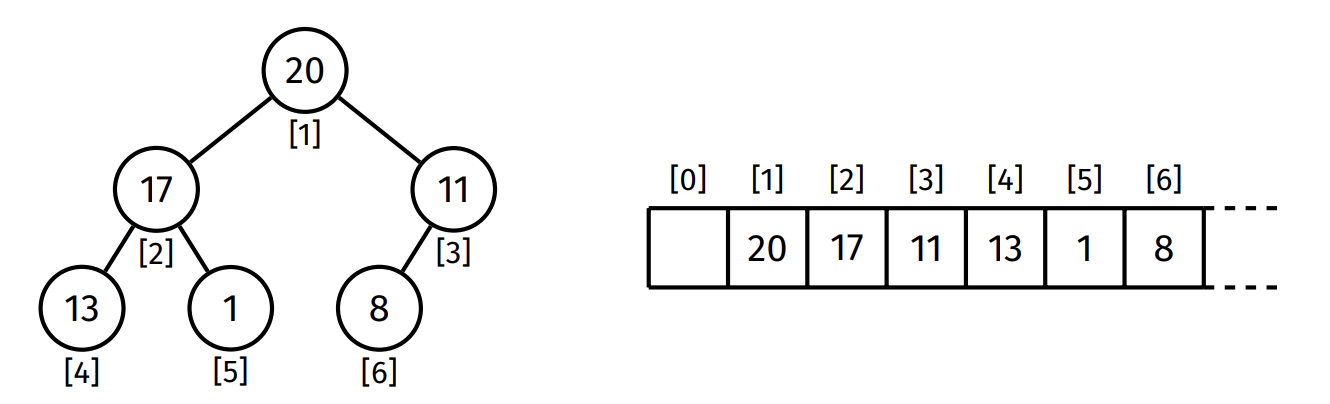
For an item at index $i$:
- Its left child is located at index $2i$
- Its right child is located at index $2i + 1$
- Its parent is located at index $\lfloor i/2 \rfloor$
Note: the following operations focuses on max heaps
Binary Heap Insertion
Insertion is a two-step process:
- Add new item at next available position on bottom level (i.e., after the last item)
- New item may violate the heap property
- Fix up: While new item is greater than its parent (and not at the root), swap with its parent
- This re-organises items along the path to the root and restores the heap property
Cost of insertion:
- Add new item after last item ⇒ $O(1)$
- Fix up considers one item on each level in the worst case
- Heap is a complete tree ⇒ $O(\log n)$ levels
- Therefore, worst-case time complexity is $O(\log n)$
Binary Heap Deletion
Deletion is a three-step process:
- Replace root item with last item
- Last item = bottom-most, rightmost item
- Let this item be $i$
- Remove last item
- Fix down: While $i$ is less than its greater child, swap it with its greater child
- This restores the heap property
Cost of deletion:
- Replace root by item at end of array ⇒ $O(1)$
- Fix down considers two items on each level in the worst case
- Heap is a complete tree ⇒ $O(log n)$ levels
- Therefore, worst-case time complexity is $O(log n)$
Using Heaps for Priority Queues
Now that we have learned heaps, we can use it to implement a more efficient priority queue.
- Insert: $O(\log n)$
- Delete: $O(\log n)$
- Peek: O(1)
- Is empty: O(1)
Heap Sort
Heap sort is a sorting algorithm that uses a heap
Method:
- Build up a heap within the original array
- This is called “heapify”
- Repeatedly delete from the heap
- Each time an element is deleted, place it at the end of the heap
Heapify (Fix Up)
- Take first element and treat as a heap of size 1
- Take next element and insert into the heap, which increases the size of the heap by one
- Repeat for remaining elements
void heapify(Item items[], int size) {
  for (int i = 1; i < size; i++) {
    fixUp(items, i);
  }
}

void fixUp(Item items[], int i) {
  while (i > 0 && items[i] > items[(i - 1) / 2]) {
    swap(items, i, (i - 1) / 2);
    i = (i - 1) / 2;
  }
}
Analysis:
- Inserting into a heap is $O(\log n)$
- Therefore, inserting n items into an initially empty heap is $O(\log 1 + \log 2 + \log 3 + … + \log n)$ = $O(\log n!)$ = $O(n \log n)$
Heapify (Fix Down)
Heapify can be implemented more efficiently by performing a fix down on every element in the first half of the array in reverse (i.e., from right to left)
Examples are in the lecture slides.
void heapify(Item items[], int size) {
  for (int i = size / 2 - 1; i >= 0; i--) {
    fixDown(items, i, size - 1);
  }
}

void fixDown(Item items[], int i, int N) {
  while (2 * i + 1 <= N) {
    int j = 2 * i + 1;
    if (j < N && items[j] < items[j + 1]) j++;
    if (items[i] >= items[j]) break;
    swap(items, i, j);
    i = j;
  }
}
This implementation of heapify is O(n).
De-Heapify
After the array has been heapified, repeatedly delete from the heap, each time placing the deleted item at the end of the heap.
void deheapify(Item items[], int size) {
  while (size > 1) {
    swap(items, 0, size - 1);
    size--;
    fixDown(items, 0, size - 1);
  }
}
Analysis:
- Deleting from a heap is $O(\log n)$
- Therefore, deleting all items from a heap of size n is $O(\log n + \log(n − 1) + \log(n − 2) + … + \log 1) = O(\log n!) = O(n \log n)$
Analysis of Heap Sort
- Heapify is $O(n)$
- De-heapify is $O(n \log n)$
- Therefore, heap sort is $O(n \log n)$
Properties:
Unstable: Due to long-range swaps
Non-adaptive: $O(n \log n)$ average case and if array is sorted
In-place: Sorting is done within original array; does not use temporary arrays